Follow us on Instagram for all the latest finds and adventures!
One-of-a-Kind Finds
Quality Assured
Sustainable Living
International Delivery
Follow us on Instagram for all the latest finds and adventures!

€ 650,00
1 in stock
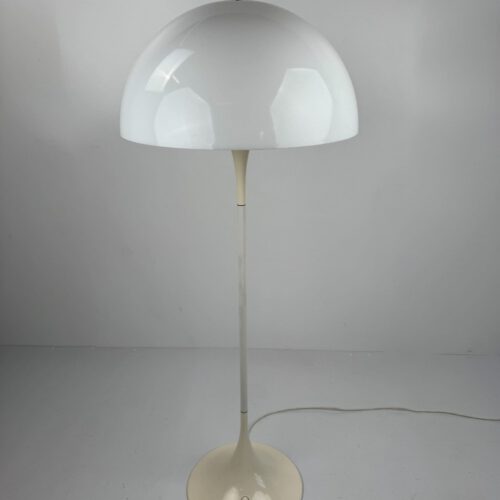
Panthella Floor Lamp, Verner Panton for Louis Poulsen, Denmark, 1970s
Designed by Verner Panton in 1971, the Panthella Floor Lamp has become one of the defining icons of twentieth-century lighting design. Its flowing, organic silhouette perfectly reflects Panton’s vision of furniture and lighting as sculptural objects rather than purely functional pieces.
The large hemispherical shade diffuses the light softly downward and outward, while the elegant trumpet-shaped stem flows seamlessly into the wide circular base. Rather than simply supporting the lamp, the base also functions as a reflector, helping to create the warm, glare-free light for which the Panthella is celebrated. Finished in glossy white with a polished chrome finial, the design feels as contemporary today as it did when it was first introduced.
The original Louis Poulsen label, marked “Made in Denmark,” remains present beneath the base, confirming its authenticity.
Designer: Verner Panton
Manufacturer: Louis Poulsen
Origin: Denmark
Period: 1970s
Model: Panthella Floor Lamp
Materials: Lacquered metal, acrylic, chrome
Dimensions: Ø 50 × H 130.5 cm
Condition: In very good vintage condition. The shade is free from cracks. The base has a few very small hairline cracks, as shown in the photographs. The lamp has been carefully cleaned, fully checked and the wiring has been inspected and replaced where necessary to ensure safe use.
Panthella Vloerlamp, Verner Panton voor Louis Poulsen, Denemarken, Jaren 70
De Panthella Vloerlamp werd in 1971 ontworpen door Verner Panton en behoort inmiddels tot de absolute iconen van de twintigste-eeuwse verlichting. Het vloeiende, organische silhouet weerspiegelt perfect Pantons visie op verlichting als een sculpturaal object, waarin vorm en functie volledig samenvallen.
De grote halfronde kap verspreidt het licht op een zachte manier naar beneden en opzij, terwijl de elegante trompetvormige stam naadloos overgaat in de brede ronde voet. Die voet is meer dan alleen een basis; hij fungeert tegelijkertijd als reflector en draagt bij aan het warme, verblindingsvrije licht waar de Panthella zo bekend om is. De glanzend witte afwerking, gecombineerd met de verchroomde knop bovenop, geeft de lamp een tijdloze uitstraling die vandaag de dag nog altijd modern aanvoelt.
Aan de onderzijde bevindt zich het originele Louis Poulsen-label met de markering “Made in Denmark”, waarmee de authenticiteit wordt bevestigd.
Ontwerper: Verner Panton
Fabrikant: Louis Poulsen
Herkomst: Denemarken
Periode: Jaren 70
Model: Panthella Vloerlamp
Materialen: Gelakt metaal, acryl, chroom
Afmetingen: Ø 50 × H 130,5 cm
Conditie: In zeer goede vintage staat. De kap is vrij van scheuren. Op de voet bevinden zich enkele zeer kleine haarscheurtjes, zoals zichtbaar op de foto’s. De lamp is zorgvuldig gereinigd, volledig nagekeken en de bedrading is gecontroleerd en waar nodig vervangen, zodat de lamp veilig gebruikt kan worden.

Few designers have challenged conventional ideas of furniture, lighting and interiors as boldly as Verner Panton. While many of his Scandinavian contemporaries refined traditional craftsmanship, Panton looked firmly towards the future. Through sculptural forms, innovative materials and fearless use of colour, he became one of the defining figures of twentieth-century design.
Although often associated with the vibrant interiors of the 1960s and 1970s, many of Panton's designs remain remarkably contemporary. His work continues to inspire architects, designers and collectors around the world, demonstrating that functional design can also be playful, experimental and deeply expressive.
Verner Panton was born in 1926 in Gamtofte on the Danish island of Funen. After studying at the Odense Technical College, he graduated in architecture from the Royal Danish Academy of Fine Arts in Copenhagen in 1951.
Early in his career he worked in the architectural practice of Arne Jacobsen, where he gained valuable experience with furniture and interior design. Although Jacobsen's work was rooted in elegant restraint, Panton quickly developed his own direction, becoming increasingly interested in new technologies, industrial production and organic forms.
In 1955 he established his own design studio, marking the beginning of a career that would redefine Scandinavian modernism.
Verner Panton believed that good design should stimulate both the senses and the imagination. Rather than treating furniture as purely functional objects, he saw interiors as complete environments capable of influencing mood and experience.
His work is characterised by:
Unlike many Danish designers who favoured exposed wood and natural materials, Panton embraced modern synthetic materials. This allowed him to create forms that had previously been impossible using conventional woodworking techniques.
His interiors often blurred the boundaries between furniture, architecture and art.
One of Panton's most significant collaborations was with Louis Poulsen, the renowned Danish lighting manufacturer.
Together they produced several iconic lighting designs that combined technical innovation with sculptural expression. Rather than simply illuminating a room, Panton designed lamps that became visual centrepieces in their own right.
The most celebrated example is undoubtedly the Panthella series, introduced in 1971. Designed as a complete reflection system, both the shade and the gently curved base distribute light softly throughout the space while giving the lamp its unmistakable silhouette.
The Panthella remains one of Louis Poulsen's most enduring and recognisable designs.
Outside Scandinavia, Panton's most influential partnership was with the Swiss manufacturer Vitra.
Together they developed the Panton Chair, the world's first one-piece cantilever chair made from a single moulded plastic shell. After years of experimentation and technical development, the chair entered production in the late 1960s and quickly became one of the most recognisable furniture designs of the twentieth century.
Its flowing S-shaped profile perfectly reflects Panton's fascination with continuous form, ergonomics and industrial innovation.
Today the Panton Chair remains in production and has become a permanent part of major museum collections worldwide.
Throughout his career, Verner Panton created an extraordinary range of furniture, lighting and interior concepts. Among his best-known works are:
Many of these designs continue to be produced today, a testament to their lasting relevance and timeless appeal.
Verner Panton occupies a unique position within Danish design history. While his contemporaries refined the traditions of Scandinavian craftsmanship, Panton expanded its possibilities through experimentation, technology and artistic freedom.
His work demonstrated that modern design could be emotional as well as functional, creating environments that were immersive, expressive and joyful.
Today his furniture and lighting are represented in museums including the Museum of Modern Art (MoMA) in New York, the Designmuseum Danmark in Copenhagen and the Vitra Design Museum in Germany. Original vintage examples remain highly sought after by collectors, while authorised reissues continue to introduce new generations to his visionary work.
More than fifty years after many of his most iconic creations first appeared, Verner Panton remains one of the most influential and recognisable designers of the twentieth century.

Founded in Copenhagen in 1874, Louis Poulsen is one of Denmark's most renowned lighting manufacturers and a leading name in Scandinavian design. For more than 150 years, the company has combined craftsmanship, innovation, and a deep understanding of light to create luminaires that are as functional as they are timeless. Today, Louis Poulsen's designs can be found in homes, public buildings, museums, hotels, and architectural projects around the world.
Louis Poulsen began as a wine import business before evolving into a tool manufacturer and, eventually, a lighting company. The brand's direction changed dramatically in the 1920s when it partnered with designer Poul Henningsen, whose pioneering work on glare-free lighting established the company's design philosophy and international reputation.
Throughout the decades, Louis Poulsen has collaborated with many of Denmark's most influential architects and designers, helping shape the development of modern Scandinavian lighting. While production methods have evolved, the company has remained committed to creating lighting that prioritizes both visual comfort and lasting quality.
At the heart of every Louis Poulsen design is the principle that light should shape the space rather than dominate it. Instead of simply designing attractive fixtures, the company focuses on how light is distributed, reflected, and experienced by the people using it.
Many of its lamps feature carefully engineered multi-shade systems that direct light precisely where it is needed while eliminating glare. This creates soft, comfortable illumination that enhances both the atmosphere of a room and the architectural environment.
Louis Poulsen has worked with some of the most celebrated figures in Danish design and architecture. Among the best known are:
These collaborations have resulted in many of the twentieth century's most enduring lighting designs.
Louis Poulsen has produced numerous lamps that have become design classics. The PH 5, introduced in 1958 by Poul Henningsen, remains one of the world's most recognisable pendant lamps and is still in production today. Other iconic designs include the PH Artichoke, PH Snowball, AJ Table Lamp, AJ Floor Lamp, Panthella, and the VL38 series.
Many of these designs have remained virtually unchanged since their introduction, a testament to their timeless aesthetics and thoughtful engineering.
Today, Louis Poulsen is widely regarded as one of the world's most respected lighting manufacturers. Its commitment to functional design, exceptional craftsmanship, and the careful study of light has made the company a cornerstone of Danish design history.
Whether produced in the 1950s or the present day, Louis Poulsen lamps continue to be valued for their quality, durability, and ability to create comfortable, inviting spaces. Their enduring popularity reflects a design philosophy that has remained relevant for generations and continues to influence lighting design around the world.
Larger pieces of furniture require a different approach than standard parcel shipping. Items such as sideboards, dining tables, chairs and cabinets are transported by experienced furniture couriers who specialise in handling vintage pieces with care.
Within the Netherlands, delivery is arranged through a selection of trusted partners, including Brenger, as well as local couriers when appropriate. For international deliveries, I work with Magic Movers, a specialist in transporting vintage and design furniture across Europe.
For these items, you'll see "Local Pickup or Courier" as the available delivery option during checkout. Courier costs are not calculated automatically, as they depend on the destination and the size of the item. Once your order has been placed, I'll get in touch with you to discuss the available transport options and provide a quotation before anything is arranged.
Prefer to know the transport costs in advance? Feel free to get in touch before placing your order. Just send me the product you're interested in together with your delivery address or postal code through one of the contact options, and I'll gladly prepare a personalised quotation.
If you prefer, you're always welcome to collect your purchase yourself from the showroom in Vinkeveen. Local pickup is free of charge, and we'll simply arrange a convenient time for collection.
You're always welcome to collect your purchase from the showroom. Simply select Local Pickup during checkout, and I'll get in touch to arrange a convenient time.
The address can be found on our contact page!
The coffee will be ready when you arrive.
Interested in this item? Simply fill out the form below and I'll get back to you with a shipping quotation. Depending on the response time of my transport partners, you can usually expect a reply within 6 to 48 hours.
Please note: Occasionally my emails end up in the spam or junk folder. If you haven't heard back within 48 hours, please check there first. If you'd like a quicker confirmation, feel free to send me a message on WhatsApp, mentioning the item you're interested in and your shipping details.