Follow us on Instagram for all the latest finds and adventures!
One-of-a-Kind Finds
Quality Assured
Sustainable Living
International Delivery
Follow us on Instagram for all the latest finds and adventures!
€ 895,00
1 in stock
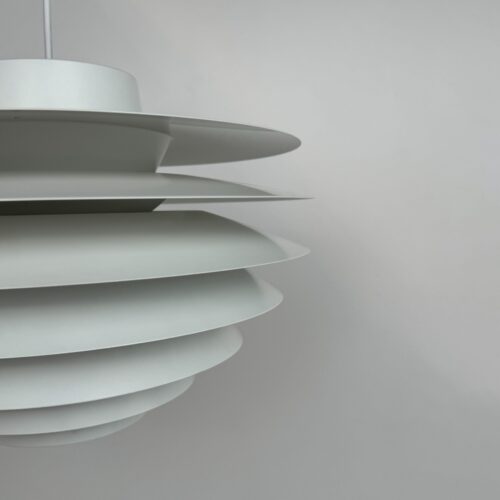
Designed by Sven Middelboe in 1968 for Lyfa, the Verona pendant is regarded as one of the defining lighting designs of Danish modernism. Its distinctive composition of concentric white lacquered steel shades creates a layered silhouette that appears almost weightless, while carefully controlling the distribution of light. Illumination is directed downward while gently reflecting between the individual shades, resulting in a soft, glare-free light.
The generous proportions make this the larger Verona model, equally suited above a dining table, kitchen island or in an open living space. Even when unlit, the sculptural arrangement of the overlapping shades gives the lamp a strong architectural presence that is characteristic of Middelboe’s restrained approach to form.
The lamp has been carefully cleaned, fully inspected and fitted with a new white textile cable. The wiring has been checked throughout, with worn electrical components replaced where necessary, ensuring it is ready for many more years of use.
Designer: Sven Middelboe
Manufacturer: Lyfa
Origin: Denmark
Period: 1968
Materials: Lacquered steel
Dimensions: H: 32.5 cm × Ø: 48 cm
Condition: Excellent vintage condition. The lamp shows only minor signs of age and use consistent with its history. It has been carefully cleaned, fully inspected, fitted with a new white textile cable, and the wiring has been checked with worn electrical components replaced where necessary.
Lyfa Verona Hanglamp, Sven Middelboe, Denemarken, 1968
Ontworpen door Sven Middelboe in 1968 voor Lyfa, behoort de Verona tot de meest karakteristieke hanglampen uit het Deense modernisme. De gelaagde opbouw van wit gelakte stalen kappen vormt een bijna zwevend silhouet en zorgt tegelijkertijd voor een zorgvuldig gecontroleerde lichtverdeling. Het licht wordt naar beneden gericht en reflecteert subtiel tussen de afzonderlijke schalen, waardoor een zachte en verblindingsvrije verlichting ontstaat.
Dit betreft de grotere uitvoering van de Verona, een formaat dat zich uitstekend leent voor plaatsing boven een eettafel, kookeiland of in een royale leefruimte. Ook zonder verlichting heeft de lamp een uitgesproken architectonische aanwezigheid dankzij de ritmische opbouw van de overlappende kappen, typerend voor de ingetogen vormtaal van Sven Middelboe.
De lamp is zorgvuldig gereinigd, volledig geïnspecteerd en voorzien van een nieuw wit textielsnoer. De bedrading is gecontroleerd en waar nodig zijn versleten elektrische onderdelen vervangen, zodat de lamp weer veilig gebruikt kan worden.
Ontwerper: Sven Middelboe
Fabrikant: Lyfa
Herkomst: Denemarken
Periode: 1968
Materialen: Gelakt staal
Afmetingen: H: 32,5 cm × Ø: 48 cm
Conditie: Uitstekende vintage conditie. De lamp vertoont slechts lichte gebruikssporen passend bij de leeftijd. Zij is zorgvuldig gereinigd, volledig geïnspecteerd, voorzien van een nieuw wit textielsnoer en de bedrading is gecontroleerd, waarbij versleten elektrische onderdelen waar nodig zijn vervangen.

Sven Middelboe was a Danish architect and lighting designer whose work embodies the clarity, balance and functional elegance of Scandinavian modernism. Although his body of work is relatively focused, he is best known for creating one of Denmark's most enduring pendant lamps: the Verona. Designed in 1968 for Lyfa, it has become an icon of Danish lighting design, celebrated for its sculptural form and its exceptional quality of light.
Born in Denmark in 1910, Middelboe trained as an architect during a period in which Danish design was increasingly defined by functionalism and careful craftsmanship. His architectural education instilled a strong understanding of proportion, structure and the relationship between form and space—qualities that would later become evident in his lighting designs.
Rather than viewing lighting as a decorative accessory, Middelboe approached it as an architectural element capable of shaping the atmosphere and character of an interior.
Middelboe believed that successful lighting should combine technical performance with visual harmony. His designs sought to eliminate glare while creating a soft, comfortable distribution of light that enhanced rather than dominated a space.
This philosophy is most clearly expressed through his use of layered shade systems. By carefully arranging multiple metal reflectors, he concealed the light source while allowing light to be reflected both downward and outward in a controlled, balanced manner. The resulting fixtures possess a striking sculptural quality without relying on unnecessary ornamentation, demonstrating the Danish principle that beauty should emerge naturally from function.
Sven Middelboe is most closely associated with Lyfa, one of Denmark's leading lighting manufacturers during the twentieth century. It was through this collaboration that his best-known designs reached an international audience.
Lyfa's precision manufacturing and expertise in metalworking enabled Middelboe's carefully engineered concepts to be realised with exceptional accuracy, preserving the subtle proportions and optical performance that define his work.
Middelboe's most celebrated design is the Verona pendant, introduced in 1968 for Lyfa. Constructed from a series of concentric white metal shades, the lamp directs light downward while softly reflecting illumination outward, creating a warm, glare-free atmosphere.
The Verona exemplifies Middelboe's architectural approach to lighting. Viewed from any angle, its stacked circular elements appear to float effortlessly around the concealed light source, giving the lamp a sense of visual lightness despite its precisely engineered construction. Decades after its introduction, the design remains one of the most recognisable Danish pendant lamps and continues to be appreciated in both period and contemporary interiors.
Although Sven Middelboe designed relatively few products compared to many of his contemporaries, the lasting success of the Verona firmly secures his place within the history of Danish lighting design.
His work demonstrates how thoughtful engineering, careful proportion and restrained aesthetics can produce designs of remarkable longevity. Original examples remain highly sought after by collectors and continue to illustrate the enduring appeal of Danish modern lighting, where technical innovation and timeless form exist in perfect balance.

Lyfa is one of Denmark's most celebrated lighting manufacturers, renowned for producing some of the defining Scandinavian lighting designs of the twentieth century. Throughout the post-war decades, the company collaborated with many of Denmark's leading designers to create luminaires that balanced technical innovation with timeless aesthetics. From sculptural multi-shade pendants to refined architectural lighting, Lyfa's collections exemplify the Danish approach to illumination: soft, functional light housed within elegantly proportioned forms.
Lyfa traces its roots to Copenhagen in the early twentieth century, establishing itself as a specialist manufacturer of high-quality lighting at a time when electric illumination was transforming homes and public spaces. As Danish design gained international recognition during the 1950s and 1960s, Lyfa became one of the country's foremost lighting producers, combining advanced manufacturing techniques with a commitment to exceptional craftsmanship.
The company developed a reputation for precision metalworking and meticulous finishing, producing luminaires that were both technically sophisticated and visually enduring. Many original Lyfa fixtures remain in daily use decades after their manufacture, a testament to the quality of their construction.
At the heart of Lyfa's philosophy is the belief that lighting should shape both atmosphere and architecture. Rather than treating a lamp as a decorative object alone, Lyfa's designs carefully control the distribution of light through layered shades, carefully calculated proportions and thoughtfully engineered reflectors.
This emphasis on glare-free illumination became a hallmark of the company. Many designs conceal the light source entirely, allowing reflected light to create a warm, comfortable environment while the fixture itself serves as a sculptural presence within the interior. The result is lighting that is equally appreciated for its visual elegance when switched off as for the quality of light it produces when illuminated.
Lyfa worked with many of Denmark's most influential lighting designers, producing models that have become icons of Scandinavian design.
Among the best known is Sven Middelboe, whose Verona pendant remains one of the defining Danish lighting designs of the late twentieth century. Its precisely layered circular shades create a floating architectural form while directing light both downward and outward in a soft, glare-free manner.
The company also collaborated with designers including Bent Karlby, Simon P. Henningsen, Ole Panton, Christian Troels, and Ib Fabiansen, each contributing distinctive interpretations of Danish modern lighting. Together, these collaborations established Lyfa as a manufacturer capable of translating innovative design concepts into finely engineered products without compromising craftsmanship or functionality.
Among Lyfa's most recognised models is the Verona, designed by Sven Middelboe in 1968. Its stacked concentric shades demonstrate the company's mastery of layered light distribution and have made it one of the most enduring Scandinavian pendant designs.
Another landmark design is Simon P. Henningsen's Divan 2, a dramatic pendant composed of coloured trapezoidal reflectors arranged in a complex geometric structure. Combining technical ingenuity with sculptural expression, it remains one of the most ambitious lighting designs of the Danish modern era.
Lyfa's catalogue also includes numerous pendant, wall and ceiling lamps characterised by clean geometry, carefully engineered reflectors and understated detailing, reflecting the company's consistent commitment to both form and function.
Lyfa occupies a significant place in the history of Danish lighting design. Its collaborations with leading designers helped establish many of the principles that continue to define Scandinavian lighting today: glare-free illumination, architectural simplicity, honest materials and enduring craftsmanship.
Original Lyfa fixtures remain highly sought after by collectors, architects and design enthusiasts worldwide. Whether installed in historic interiors or contemporary spaces, they continue to demonstrate the timeless relevance of thoughtful lighting design, where technical precision and visual restraint combine to create objects of lasting beauty.
Larger pieces of furniture require a different approach than standard parcel shipping. Items such as sideboards, dining tables, chairs and cabinets are transported by experienced furniture couriers who specialise in handling vintage pieces with care.
Within the Netherlands, delivery is arranged through a selection of trusted partners, including Brenger, as well as local couriers when appropriate. For international deliveries, I work with Magic Movers, a specialist in transporting vintage and design furniture across Europe.
For these items, you'll see "Local Pickup or Courier" as the available delivery option during checkout. Courier costs are not calculated automatically, as they depend on the destination and the size of the item. Once your order has been placed, I'll get in touch with you to discuss the available transport options and provide a quotation before anything is arranged.
Prefer to know the transport costs in advance? Feel free to get in touch before placing your order. Just send me the product you're interested in together with your delivery address or postal code through one of the contact options, and I'll gladly prepare a personalised quotation.
If you prefer, you're always welcome to collect your purchase yourself from the showroom in Vinkeveen. Local pickup is free of charge, and we'll simply arrange a convenient time for collection.
You're always welcome to collect your purchase from the showroom. Simply select Local Pickup during checkout, and I'll get in touch to arrange a convenient time.
The address can be found on our contact page!
The coffee will be ready when you arrive.
Interested in this item? Simply fill out the form below and I'll get back to you with a shipping quotation. Depending on the response time of my transport partners, you can usually expect a reply within 6 to 48 hours.
Please note: Occasionally my emails end up in the spam or junk folder. If you haven't heard back within 48 hours, please check there first. If you'd like a quicker confirmation, feel free to send me a message on WhatsApp, mentioning the item you're interested in and your shipping details.